Thalassemia trait is not an illness. It means you carry one altered copy of the gene that makes haemoglobin. Most carriers feel completely well and never need treatment. It matters for one reason: if two carriers have children together, each child has a chance of being born with thalassemia major.
What "trait" actually means
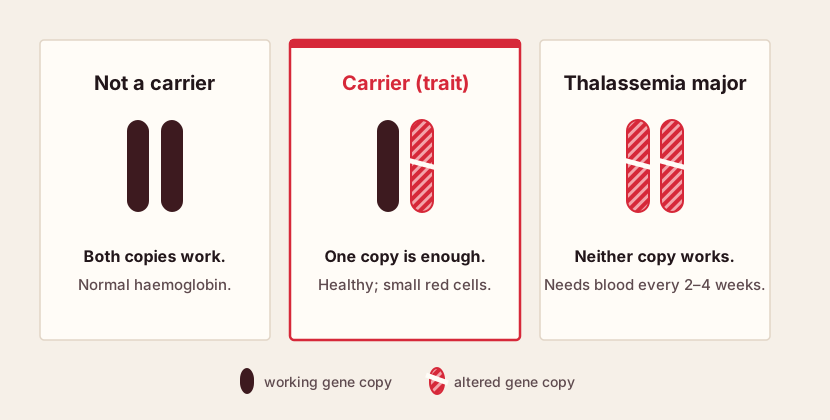
Haemoglobin is the protein in red blood cells that carries oxygen around the body. Part of it, called beta-globin, is made from a gene we each inherit twice: one copy from our mother and one from our father.
A person with thalassemia trait (also called a carrier or thalassemia minor) has one working copy and one altered copy. The working copy does enough of the job on its own. A person with thalassemia major has two altered copies, so their body can't make enough healthy haemoglobin, and they need blood transfusions every 2–4 weeks for life.
How does it feel to be a carrier?
Usually, it doesn't feel like anything. Carriers can study, work, play sport, fast and live a normal life. The trait never turns into thalassemia major, and it isn't contagious: you can only be born with it.
Some carriers have mild anaemia and may feel a little tired, especially during pregnancy. Women who are carriers should tell their doctor when they are expecting, so their blood can be checked along the way.
How it shows up on a blood test
Carriers make red blood cells that are smaller than usual, but often more of them. That pattern shows up on an ordinary blood count, and a second test, which measures a type of haemoglobin called HbA2, confirms it.
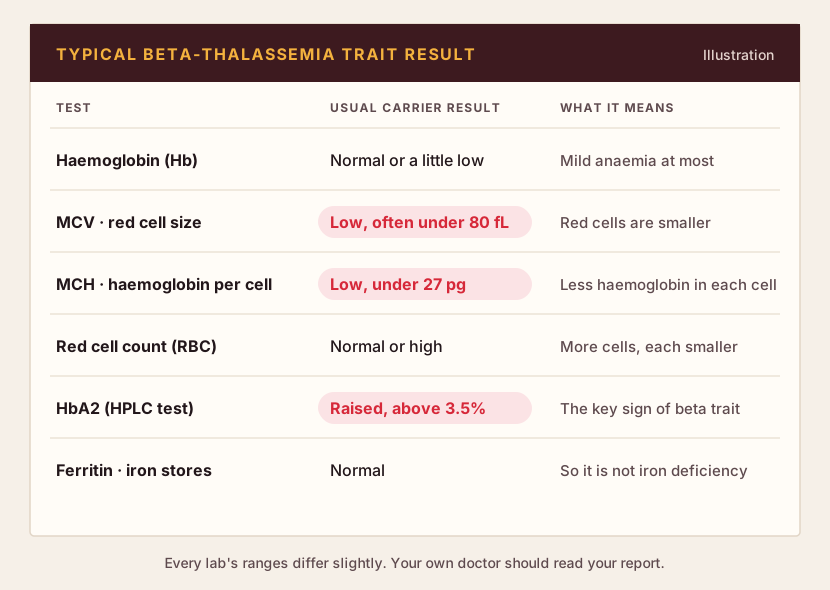
- CBC (complete blood count): small red cells (low MCV and MCH) with a normal or high red cell count.
- HbA2 by HPLC or electrophoresis: a level above about 3.5% usually confirms beta-thalassemia trait.
- Ferritin: checks your iron stores, so the trait isn't confused with iron deficiency.
Don't take iron "just in case"
Small red cells are often blamed on low iron, so many carriers are given iron tablets they don't need. Extra iron does not fix thalassemia trait, and over time it can build up in the body. Take iron only if a ferritin test shows your iron is actually low.
Why it matters before marriage
If only one partner is a carrier, none of your children can have thalassemia major, although some may be carriers. If both partners are carriers, every pregnancy has the same odds.
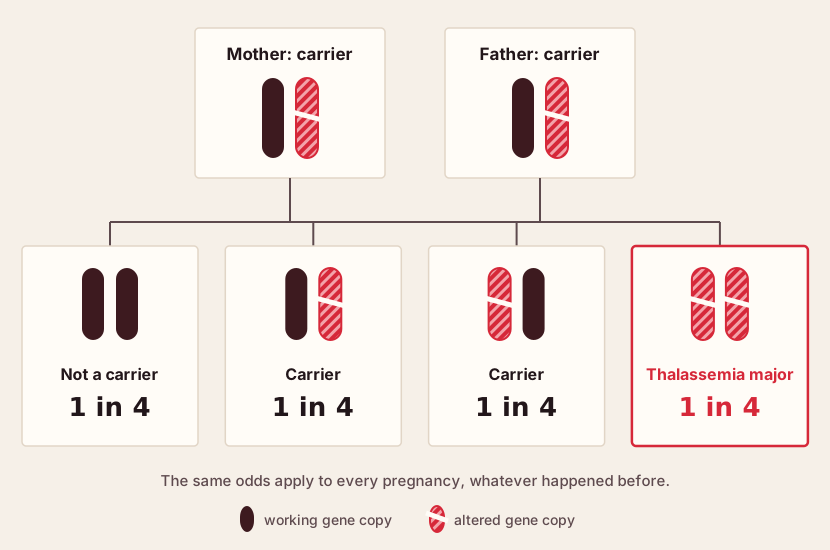
Between 5 and 7 percent of people in Pakistan carry the trait, most without knowing it. The chance that both partners are carriers is higher when marriages are within the family, because relatives are more likely to share the same gene.
If you are both carriers
You are not alone, and you have choices. A counsellor can explain your options in private and without judgement, including a test during early pregnancy that shows whether the baby is affected. Knowing early gives families time to decide what is right for them, with medical and religious guidance.
Who should get tested?
- Anyone planning to marry, ideally before the families decide.
- Brothers, sisters and cousins of a child with thalassemia, or of a known carrier.
- Couples planning a pregnancy who have never been tested.
- Anyone told they have "iron deficiency" that doesn't improve with iron tablets.
The test is one small blood sample, and you only ever need it once in your life. At Sehar Foundation, carrier testing is free.
There is also a rarer type, alpha-thalassemia trait, which has a normal HbA2 level and needs a DNA test to confirm. If your red cells are small but your HbA2 and iron are normal, ask your doctor about it.